Physical Address
304 North Cardinal St.
Dorchester Center, MA 02124
Physical Address
304 North Cardinal St.
Dorchester Center, MA 02124
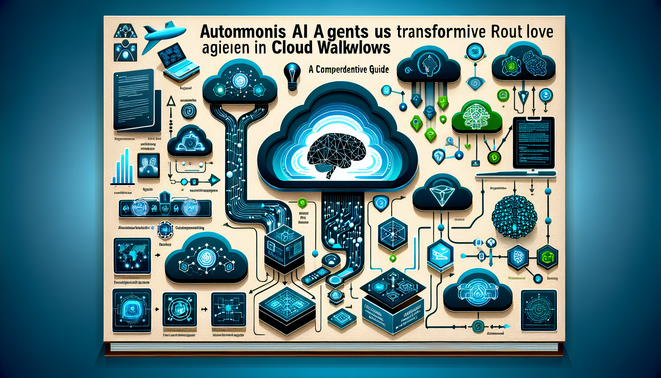
Autonomous AI Agents in Cloud Workflows: A Comprehensive Guide
Meta Summary: Explore the transformative role of autonomous AI agents in cloud workflows. Discover their architecture, integration with APIs, real-time decision-making capabilities, and best practices for implementation to maximize efficiency and reduce costs.
Introduction to Autonomous AI Agents
In the fast-evolving landscape of cloud computing, autonomous AI agents have become pivotal in cloud workflows, enhancing efficiency and cutting operational costs by executing tasks and making decisions independently.
What is an Autonomous AI Agent?
An Autonomous AI Agent is a sophisticated system capable of independently performing tasks and making decisions within a cloud workflow. These agents process vast amounts of data, learn from it, and take actions aligning with predefined objectives. They consist of a robust decision-making engine, a learning mechanism, and an interface for interaction with systems and data sources.
The role of autonomous AI agents in cloud workflows includes streamlining operations by automating routine tasks, optimizing resource allocation through informed decisions, and enhancing overall cloud service agility. By integrating seamlessly into existing cloud infrastructures, these agents drive higher efficiency and innovation.
Architecture of AI Agents in Cloud Workflows
The architecture of AI agents in cloud workflows is designed for seamless data flow and decision-making processes, leveraging cloud resources to ensure scalability and reliability.
Key Components of AI Agent Architecture
The architecture consists of several layers:
Data Input Layer: Responsible for data ingestion from various sources, providing AI agents the information needed for decision-making.
Processing Layer: Utilizes advanced algorithms and machine learning models to analyze data, identify patterns, and make predictions.
Decision-Making Layer: Converts processed data into decisions using techniques like decision trees and neural networks.
Output Layer: Acts on decisions, executing actions like sending alerts, updating databases, or closing transactions.
Cloud-based workflow systems collect data, process it through AI models, and execute decisions, with a modular design allowing updates or replacements without system disruption.
Integration with APIs for Workflow Automation
API integration is crucial for automating cloud workflows, enabling the seamless exchange of data and task execution essential for autonomous AI agents.
How API Integration Works
API Integration involves connecting software applications to enable data sharing and communication. For autonomous AI agents, effective API integration boosts task automation and workflow efficiency.
Organizations can use tools like Zapier, Mulesoft, or AWS API Gateway for seamless system connections, allowing AI agents to access and manipulate data from various sources.
Tip: Practice by creating a simple autonomous AI agent that accesses a public API to process data or designing an automated workflow integrating multiple APIs for business process streamlining.
Real-time Decision Making and Feedback Loops
Real-time decision making and feedback loops are fundamental for AI agents’ performance, allowing them to adapt dynamically and continuously optimize cloud workflows.
Importance of Real-Time Feedback
Real-time Decision Making enables AI agents to process data and make decisions instantaneously, critical in applications like fraud detection or dynamic pricing.
A Feedback Loop is a system where output becomes input for further iterations, enhancing workflows by enabling AI agents to learn from past actions and improve decision-making over time.
Note: Incorporating feedback loops ensures continuous improvement in AI agents, boosting efficiency and adapting to new challenges in real-time.
Scaling Automation in Enterprise Cloud Services
Scaling automation allows enterprises to manage large-scale workflows efficiently, with autonomous AI agents being key to scalability and sustaining performance under increasing demands.
Strategies for Scaling AI Agents
Organizations need robust strategies for scaling AI agents:
Horizontal Scaling: Involves adding more AI agent instances to share workloads.
Vertical Scaling: Enhances existing agents by upgrading hardware or software capacities.
Scalability ensures that cloud services manage more data and transactions without performance dips and maintain service levels during peak demands.
Use Cases and Benefits of Autonomous AI Agents
Autonomous AI agents bring numerous advantages across various sectors, from automating customer support to optimizing supply chains, driving efficiency, and improving customer satisfaction.
Exploring Use Cases
Customer Support Automation: AI agents handle basic inquiries, allowing human agents to focus on complex issues, as seen in Company XYZ’s customer support workflow automation, resulting in significant time and cost savings.
Supply Chain Optimization: Agents predict demand, optimize inventory, and manage logistics, reducing delays and costs.
Financial Services: Autonomous agents monitor transactions for fraud, ensuring compliance and security.
The business value in Cloud SaaS lies in consistent service delivery, resource optimization, and innovation by reallocating human resources to strategic roles.
Best Practices for Implementation
Implementing autonomous AI agents requires best practices to ensure successful operation, focusing on testing, monitoring, and governance to maximize AI benefits.
Recommended Practices
Conduct Thorough Testing: Test AI agents in controlled settings to identify issues prior to full deployment.
Continuous Monitoring: Maintain AI agents’ performance by monitoring and adapting them to evolving business needs.
Security and Governance: Employ strong security and governance frameworks for data protection and regulatory compliance.
Following these practices mitigates risks and ensures AI agents’ seamless integration into cloud environments.
Common Pitfalls and How to Avoid Them
Implementing AI agents can face challenges if not addressed properly, leading to inefficiencies or security vulnerabilities. Understanding and avoiding common pitfalls is crucial for a successful deployment.
Common Pitfalls
Neglecting Data Privacy and Security: Insufficient data protection can result in breaches and compliance issues.
Overcomplicating Workflows: Complex workflows may become ineffective and hard to manage.
Ignoring User Feedback: Lack of user feedback integration can result in systems not meeting user needs.
To prevent these issues, prioritize data security, simplify workflows, and actively incorporate user feedback in the development cycle.
Visual Aids Suggestions
Flowchart of an Autonomous AI Agent’s Architecture: A visual diagram detailing data input, processing, and decision-making paths helps illustrate AI agent operations in cloud workflows.
Key Takeaways
Autonomous AI agents are crucial for cloud workflow efficiency and cost reduction.
Grasping AI agents’ architecture and API integration is key for effective automation.
Real-time decision making, feedback loops, and scaling automation are vital for enterprise efficiency.
Best practices and understanding pitfalls ensure successful AI agent implementation.
Glossary
Autonomous AI Agent: An independent AI system performing tasks and decisions in a cloud workflow.
API Integration: Connecting apps for data communication and sharing.
Feedback Loop: Using process output as input for improvement.
Cloud SaaS: Software delivered over the internet hosted in the cloud.
Knowledge Check
What is an autonomous AI agent? (MCQ)
Explain how feedback loops enhance the performance of cloud workflows. (ShortAnswer)
Name two strategies for scaling AI agents in cloud services. (ShortAnswer)
Why is real-time decision making critical for autonomous AI agents? (MCQ)
List one common pitfall when implementing AI agents and how to avoid it. (ShortAnswer)
Further Reading
Azure Cognitive Services Overview
AWS Machine Learning
IBM Cloud Learn: Machine Learning
